Abel Ferrara’s Mary

I finally caught up with Abel Ferrara’s 2005 film Mary: it was the one Ferrara feature (excluding his pre-Driller Killer pornos) that I had never seen before. Needless to say (at least for me, since I have expressed my enthusiasm for Ferrara before, and also, long ago here), it’s amazing. It’s hard to get a total grip on Mary after just one viewing, but I will do my best.

Mary is apparently Ferrara’s response to Mel Gibson’s Passion of the Christ. It concerns a macho-asshole film director (played by frequent Ferrara alter ego Matthew Modine) who has made a film, This Is My Blood, about the life of Jesus, in which he also played the title role, and who is now trying to promote the film, in the face of protests both by Jews (who consider it anti-Semitic) and Christian fundamentalists (who consider it heretical). Strictly speaking, the fundamentalists are right, since the film emphasizes the role of Mary Magdalene as a key disciple of Jesus, drawing upon various suppressed, heretical Gospels. Mary clashes repeatedly with Peter, who seems to reject her role as a disciple largely on sexist grounds. The revisionist reading of Magdalene is supported by interview footage with Elaine Pagels and several other (real-life) scholars and theologians who have worked on early Christianity.

Though Mary does have characters and a straightforward narrative, it is also very much of a collage film. We see scenes from the film Modine’s character has made, together with various other types of footage from the (fictional) world in which Modine’s character lives, together with documentary, or documentary-style footage. The scenes from This Is My Blood are gorgeous, in murky chiaroscuro, with a mobile camera that frequently stays close enough to the actors that all we can see are their faces, filling the screen, emerging out of, and returning to, the shadows. Despite the director’s egotistical stunt of playing Jesus, the weight of this film-within-the-film clearly rests with the actress playing Mary, whose feelings — from the mournfulness of witnessing Jesus’ death, to the joy of his resurrection, and the message (rejected by Peter) that she has gotten from him — are subtly, but powerfully, modulated throughout these chiaroscuro sequences.

Mary starts with the film’s final wrap, and mostly takes place a year later, in New York, as Modine is preparing for the premiere. But another plot strand involves the actress playing Mary (this character is played by the great — and woefully underappreciated in the US — Juliette Binoche). Binoche’s character has overidentified with her role; she can’t let go of Mary Magdalene — and she drops everything in order to go to Jerusalem, where she wanders the streets and jostles the crowds on a spiritual quest. The scenes involving her seem to be shot on location, with handheld camera, and bright and even natural lighting; we see documentary-ish scenes of Jewish, Christian, and Muslim prayer, together with ones of her roaming the streets. She embraces the Wailing Wall (?), takes part in a Seder that is interrupted by a terrorist attack (with the fact that the Last Supper was a Seder clearly on her, and Ferrara’s, mind), and prays at the Church of the Nativity in Bethlehem (I think). Binoche has very little dialogue, but anguish (and later, peace) are etched on her face throughout these scenes of quest. And there is an emotional continuity (beyond the stylistic differences) between her scenes in Jerusalem, and those in the film-within-the-fillm.

I still haven’t mentioned the most extended narrative strand in Mary, which involves an intellectual (as in Charlie Rose, or someone else on PBS) talk-show host (played by Forest Whitaker), who is doing a series of shows focusing on the actual, historical Jesus — hence the interview material with theologians and Biblical scholars. Between his preparations for the series, and his general philandering, Whitaker’s character is woefully neglecting his late-term-pregnant wife (played by Heather Graham), and generally making a mess of his life. Whitaker interviews Modine (and Binoche via telephone) on his show, which is the minimal way in which the various plot strands intersect.

The New York scenes, involving Modine and Whitaker, are mostly at night — they feature the poetry of distantly-lit office skyscrapers, briidges, and freeways, contrasting sharply with both the chiaroscuro of the film-with-in-the-film, and the clarity of light of the Jerusalem sequences. Whitaker is also often seen in his TV studio, surrounded by video monitors that are usually showing either interview footage, or else the news: domestic (US) riots and crime scenes, and political violence in Israel and Palestine. There are also other dissonant moments; at one point, somebody throws a rock through the window of a limousine in which Whitaker is negotiating with Modine, and the confrontation is shown in music-video style, with swish pans and jump cuts. Throughout the New York scenes, there are also lots of tracking shots down corridors (and sometimes back as well), the vertiginous camera movement accenting the increasingly unhinged emotions of the characters.

So the film is wildly disjunctive stylistically, as well as disjointedly multi-stranded narratively. It’s as if this promiscuously jarring mixture of styles and media were the only way Ferrara could express the actuality of life in the 21st century — and this, in turn, is necessary in order to make the film’s spiritual explorations vital and meaningful, instead of merely antiquarian. As the film proceeds, things become more and more unhinged. Modine confronts the protesters at his film’s premiere; when a bomb threat empties the theater, he locks himself in the projection room and rolls the film despite the absence of spectators. Meanwhile, Whitaker is not there for his wife when she goes into labor and gives birth to a baby boy whose survival is in doubt (it was unclear to me whether this was a case of birth defects or just premature birth; in any case, there’s an amazing scene of the baby, crying and crying while encased in a plastic bubble, as Whitaker tries futilely to comfort the child). By the end of the film, Binoche, surrounded by violence, seems to find a sort of inner peace, while Modine is in the throes of a full-fledged ego breakdown, and Whitaker, weeping, throws himself before the Cross.

All this echoes moments of spiritual intensity in other films by Ferrara (Harvey Keitel abjecting himself at the end of Bad Lieutenant; or the peace that Lili Taylor perhaps finds at the very end of The Addiction). Mary is, I think, the equal of those earlier films. Its greater heterogeneity or fragmentation perhaps lessens the emotional impact a bit, but it has the effect of making Ferrara’s spiritual claims more compelling than ever before. It’s useless to ask whether Ferrara is in a literal sense “religious”; I am inclined to agree, however, with Dennis Lim’s suggestion that Mary is “the rare movie that could stand as a rebuke to both The Passion of the Christ and Religulous.” Ferrara’s sensibility is, of course, deeply Catholic; but this is inflected, in Mary, both by a concern for Judaism (which Ferrara comes back to again and again, throughout the film) and by a general heretical/quasi-feminist edge. The recentering of the film’s implicit theology around Mary Magdalene is expressed through a delirious male abjection before the feminine (in terms both of the role of Binoche, and Whitaker’s hysterical-yet-moving repentance for how he has wronged Graham). One can rightly say that such an inversion of the masculine arrogance Modine’s and Whitaker’s characters both represent is not truly feminist, because it just inverts the gender stereotypes, rather than actually undoing them. But the film’s masculine hysteria is inseparable from its spiritual longings; by which I mean one cannot reduce either of these dimensions to being merely a displaced symptom of the other — they must both be accepted and taken seriously, together. And, looking at the film this way, it charts, and makes, a convulsive emotional movement that is its own evidence and justification. Ferrara’s greatness as an affective filmmaker is unparalleled, and has never (apart from Nicole Brenez’s wonderful book) gotten the recognition that it deserves. Ferrara breaks down the distinction between art film and exploitation film, just as he does between spirituality and sleaze. He is absolutely contemporary, and yet he pushes beyond the cheap irony and encapsulated soundbytes of all too much contemporary culture.

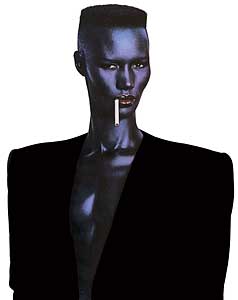
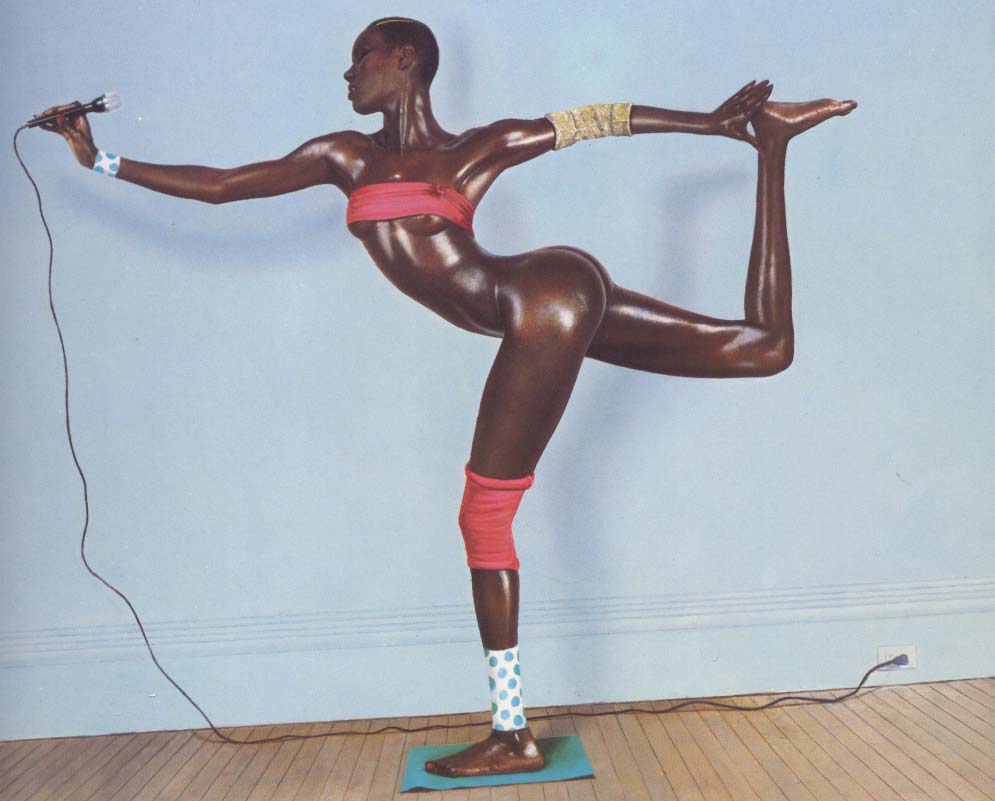
Grace Jones, Corporate Cannibal

“Corporate Cannibal”, the new Grace Jones video (directed by Nick Hooker) is utterly astonishing. Jones is 60 years old (!); and this is the first new work she has released in close to twenty years. But “Corporate Cannibal” is anything but safe and nostalgic.

Corporate Cannibal

The video is in black and white, and the only images that appear on the screen are those of Grace Jones’ face and upper body, black against a white background. But Jones’ figure is subject to all sorts of electronic distortions. The most common effect is one of elongation: her face is stretched upwards, as if she had an impossibly long forehead, as if her notorious late-80s flattop haircut had somehow expanded beyond all dimensions. Or else, her entire body in silhouette is thinned out, gracile (if that isn’t too much of a pun), and almost insectoid. The image also bends and fractures: her mouth stretches alarmingly, her eyes bulge out and expand across the screen like some sort of toxic stain. And sometimes Jones’ figure multiplies into two or three distorted, and imperfectly separated, clones. Nothing remains steady for more than a few seconds; the screen is continually morphing, and everything is so stylized and disrupted that we don’t get a very good sense of what Jones actually looks like today. Her facial features remain somewhat recognizable — Grace Jones has never looked like anyone else — and at a few moments, we get a brief almost undistorted close-up of her eyes, nose, and mouth — but there is something monstrous as well about this individuated “faciality”; and in any case it is gone almost before we have had the time to take it in.

Corporate Cannibal

The electronic manipulation of Jones’ image throughout the video is reminiscent of the ways that Nick Hooker manipulated images in his earlier videos — except that those earlier videos are in full color, and they generally appear trippy and pyschedelic. There is nothing of that feel in “Corporate Cannibal,” which is altogether violent, ferocious, and sinister. This is due partly to the starkness of the black and white; and partly to the harsh minimalism of the video, which returns insistently to the same few distorted poses, even though it is unstable and continually in flux. Hooker’s color videos are about free-flowing metamorphosis; but “Corporate Cannibal” is about modulation, which is something completely different. I mean that modulation is schematic and implosive, rather than free-floating and expansive. The modulations of “Corporate Cannibal” don’t give us the sense that anything can happen, but rather one that no matter what happens, it will be drawn into the same fatality, the same narrowing funnel, the same black hole (again, I am not sure whether this is the right pun), the same code of electronic processing and morphing. There is no proliferation of meanings, but rather a capture of all meanings, as they are drawn down into the same obsessive grid of distortions and transformations.

Although the video’s background is white, and Grace’s figure is black (again, can we separate how this works and what it means pictorially, from how it works and what it means racially?), nonetheless the video as a whole does not suggest any sort of figure-background relationship. It is rather the case that Jones’ distorted body is a signal traversing an (otherwise blank and empty) field — there is nothing there besides this figure, no background at all. This also means that the video is not a “picture” or a “representation” of Jones’ face or body; the video image does not refer to a source or model beyond itself. Rather, Jones’ figure is itself the electronic image or signal — rather than an external referent to which this image/signal would refer. Indeed, at the very start of the video, and at certain moments within it, it is impossible to decide whether what we are seeing is a manipulation and distortion of Jones’ figure, or whether it is just “noise” or feedback, an artifact of the electronic manipulation field itself. For Grace Jones’ body and voice are themselves, already, electricity, light (or darkness) and sound, digital matrix and intense vibration. The video is modulating Jones-as-signal, rather than distorting some pre-existing image-of-Jones-as-real-body. The electronic image is itself a visceral embodiment of Jones, rather than being an immaterial picture of an embodiment that would exist elsewhere. And Hooker is not manipulating her image, so much as he is modulating the electronic signal that she already is (and, presumably, doing this at her command).

Corporate Cannibal

In this sense, “Corporate Cannibal” is the latest in a long history of Grace Jones’ reinvention of herself, via the rearrangement of her body. Jones’ performances in the 1980s can be contrasted with those of Madonna. Both singers emerged from the world of disco, and from a culture of campy performance that was largely associated with gay men. Both became gay icons, as women “performing” femininity rather than naturalizing it. Both flaunted an aggressive sexuality that was at odds with the old-style patriarchal norms of what women should be like. And both grasped the ways that this post-second-wave-feminism sexual “freedom” was deeply complicit with consumerist commodification, i.e. with the way that it was not just particular objects that worked as commodities, but that lifestyles, personalities, etc., were themselves increasingly being commodified.

And yet, despite this common ground, there was (and is) a vast difference between these two performers. Madonna put on and took of personas as if they were clothes; indeed, the clothes were often what made the persona. The brilliance of this strategy was the way it suggested that everything was postmodern surfaces, or styles. There was nothing beneath the surface, no depths and no essences. Every “identity” was factitious; and this allowed Madonna to play with them, freely and pleasurably. Because these personas were all stereotypes and fictions, none of them had any real consequences, none of them were irreversible, and none of them had any cost other than the up-front financial one.

Grace Jones’ transformations were altogether more troubling, more aggressive, and more transgressive. In a sense, these transformations were incised more deeply in the flesh, for all that they were (no less than Madonna’s) a matter of clothes and styles and the powers of the fashion world. In part, Jones’ transformations were “deeper” than Madonna’s because they had to be: without Madonna’s white skin privilege, Jones couldn’t treat her self-mutations as casually as Madonna did. She couldn’t retreat to the anonymity that was the implicit background of Madonna’s performances, the neutrality and lack-of-depth that existed (or rather, didn’t exist) behind all the costumes. Grace Jones (nee Grace Mendoza), as a black woman, is always already “marked” as a body — in a way that Madonna Ciccone is not; which means that she cannot simply dismiss depth, and present a play of pure surfaces, the way that Madonna can. She had much more at stake in her metamorphoses than Madonna ever could have had.

And so, if Madonna’s transformations were always playful and fantasy-like, Grace Jones’ transformations were considerably harder and harsher — which doesn’t mean that they were devoid of pleasure, but that Jones’ own pleasure in them was not necessarily something that she shared with her audience — her figures, unlike Madonna’s, are not necessarily ones you can identify with. (Think of the difference between the coyness of Madonna’s “Like a Virgin” and the Ballardian savagery of Jones’ “Warm Leatherette”). Another way to say this is to say that Jones is definitely a dominatrix, while Madonna isn’t (even if she sometimes plays around with the edges of s&m). Yet another way is to say that, while Madonna plays with the image of “femininity,” pointing out its artifice, its artificiality, and its inessentiality, Grace Jones instead blasts this “femininity” apart, blows it up altogether. Her metamorphoses always have a transgressive edge. She assaults the divisions between male and female not with a cozy androgyny, but with a cold and forbidding, ungenderable more-than-masculine hardbody. She similarly assaults the divisions between white and black by simultaneously embracing the worst stereotypes and snarling Fuck You at them. In messing so seriously with both gender and race, Jones pushes beyond the human, transforming herself (before it became fashionable) into a posthuman or transhuman, a robot; or even more, as k-punk suggests, into a chilly and affectless object-machine, whose “screams and the laughter seem to come from some Other place, a dread zone from which Jones has returned, but only partially. Is it the laughter of one who has passed through death or the scream of a machine that is coming to life?”

The difference between Madonna and Grace Jones is therefore both affective and ontological. Where Madonna is playful, Jones is playing for keeps. And where Madonna critiques subjectivity by suggesting that it is just a surface-effect with nothing behind it, Jones critiques it by actually delving beneath the surfaces, or into the depths of the body, to discover a dense materiality that is not subjective any longer. Jones no longer accepts the subordination that Western culture has so long written into the designations of both “woman” and “black”; but she does this neither by recuperating femininity and blackness as positive states, nor by claiming for herself the privileges of the masculine and the white; but rather by subjecting the whole field of these oppositions to radical distortion, to implosion, or to some sort of hyperspatial torsion and distortion.

“Corporate Cannibal” is entirely consistent with Jones’ past experiments, and in fact pushes them to a new extreme. Our technologies have ramified and changed since the 1980s, and Jones has followed them by emerging as the new video flesh (in a manner that was prophesized by Cronenberg’s Videodrome, a film that came out at the same time as Jones’ greatest hits — the early/mid 1980s — but that today, in “Corporate Cannibal,” is no longer a matter of prophecy and science-fictional extrapolation, but simply one of sheer present actuality). In the video, Jones is frightening, ferocious, predatory, vampiric. She has become pure electronic pulse, materiality of the electronic medium (which we were always wrong to consider intangible, dematerialized, or disembodied) — and she will utterly devour and destroy (convert into more image, more electronic pulse, more of herself) whatever thinks it might be able to stand apart from the process.

All this is made explicit in the lyrics to “Corporate Cannibal”: but conversely, these lyrics only have their extrarordinary effect because they have found the proper regime of images to make them operative. Jones’ voice is at first wheedling (“Pleased to meet you/ Pleased to have you on my plate”), before it turns stentorian, imperative, and threatening; and at the end of the song it modulates again, beyond words, into a predatory growl or snarl. She is telling us flatly that she will destory and devour us (“I’m a man-eating machine… Eat you like an animal… Every man, woman, and child is a target”). She is a vampire, but not a romantic one: rather, the song expresses Jones’ absolute identification with Capital as a vampiric force (remember that Marx long ago described capitalism as vampiric: “Capital is dead labor, which, vampire-like, lives only by sucking living labor, and lives the more, the more labor it sucks”). Jones sings: “I deal in the market… A closet full of faceless, nameless, pay-more-for-less emptiness… You’ll pay less tax but I will gain more back… I’ll consume my consumers.” Her lyrics absurdly juxtapose the cliches of corporate-speak (“Employer of the year”) with those of pulp horro (“Grandmaster of fear”). All this is set against a grinding, dissonant musical accompaniment, with harsh backbeats and shrieking guitars that are, however, more downbeat than metal (a number of blogs have compared the music to that of Massive Attack a decade ago, at the time of their album Mezzanine).

The overall effect is terrifying, although the terror is overlaid with an awarness of the cliches or stereotypes of that which induces terror. This is extreme expression for a world in which there are no longer any extremes, because everything can find the niche in which it is marketable. Grace Jones is forcing us to confront the way in which, today, even the transgression that might have thrilled us twenty-five years ago is little more than another marketing strategy. Or the way in which, beyond all those discourses about race and gender and “the body,” the only thing that is “transgressive” today is Capital itself, which devours everything without any regard for boundaries, distinctions, or degrees of legitimacy; which “transgresses” the very possibility of “transgression,” because it is always only transgressing itself in order to create still more of itself, devouring not only its own tail but its entire body, in order to achieve even greater levels of monstrosity. Or, as Dejan puts it, in the video “you can see directly the intimate bond between animation and the mutability of Capital,” as Jones’ electronic mutations or modulations track and embrace and coincide with the metamorphoses of Capital itself, in our world of delirious financial flows and hedge funds and currency manipulations and bad debts passed on from one speculator to the next — all of which depend upon, and indeed energize, the same digital technology that also makes Nick Hooker’s video manipulations possible. I think that “Corporate Cannibal” — with its continual modulations and deformations that are no longer just on the surface of the world but inhabit and shape its depths, and with its violent Weird energy (in the sense of post-Lovecraftian “weird fiction” with its simultaneous slight hokiness and intense anxiety and dislocation) — gives the most profound expression or articulation that I have yet come across to the affect of the vertiginous “globalized network society” we live in today.

My Winnipeg

Guy Maddin has really been on a tear lately. With Cowards Bend the Knee (2003), Brand Upon the Brain! (2006), and now My Winnipeg (2007), he has been making the best films of his career. My Winnipeg is a little different from the others, in that it is ostensibly a documentary. It is supposedly Maddin’s personal portrait of his home town, though it mixes actual documentary content with material that is hallucinatory and fantasmatic — both in relation to the actual history of Winnipeg, and in relation to Maddin’s own personal history.

What this means in practice is that there is less emphasis on plot than in most of Maddin’s films — My Winnipeg does not have all the overwrought twists and turns of melodrama with which Maddin’s earlier films are packed, and instead is more of a free-floating, nonlinear collage. Actual documentary footage is mixed with fake documentary footage,real and fake present-day footage, and bizarre “reenactments” (together with shadow-puppet reconstructions and some stock footage). The emotional center of the film is autobiographical (or so Maddin claims) — the central character is supposedly “Guy Maddin,” and there’s a lot of material reminiscent of the family triangle in Cowards Bend the Knee! — with the mother’s beauty parlor and the father’s work for the hockey team — and of the monstrous mother of Brand. But this is mixed with accounts of Winnipeg’s history — some of which is, more or less, true (like an account of the Winnipeg general strike of 1919), but most of which is evidently invented (such as the claim that Winnipeg is especially noteworthy for its large number of sleepwalkers).

In fact, sleepwalking provides the major organizing metaphor for My Winnipeg. The film starts with “Guy Maddin” (played by an actor, though the voiceover which provides the film’s narration is, I believe, actually Maddin’s own) asleep on the train, trying to leave town. His voiceover monologue speaks of his continual attempts to leave the city, and his utter inability to do so. Winnipeg is a dream, a fantasmagoria, from which he is unable to awaken. The city is filled, Maddin tells us, with sleepwalkers wandering through the snow, back to their childhood homes, to which they still possess keys, and where the current owners are legally obligated to let them back in. Maddin himself, and all Winnipeggers, are ceaselessly trying to return to a past that they cannot recapture, though its ghosts (or hauntological traces) are everywhere and cannot be effaced. Maddin has always used deliberately degraded black and white film footage, shot in styles that emulate silent film, in order to show us images that are explicitly in the past tense, rather than the present (of course film is actually in the past, but most films strive to give us the illusion of heightened presentness and presence. Film’s extraordinary immediacy and intensity gives it a sense of presence almost by default, and this is what Maddin is always engaged in fighting against). Here he raises this pastness to a meta-level: nearly everything that he shows us no longer exists, and his documentary images are signs of this having-perished.

CIty history and family history run parallel. The “Forks” — the triangular confluence of rivers around which the city was built — is conflated with the (similarly shaped, i.e. vaginal) lap of the mother, from whom Maddin seems unable to tear himself away. The film slips back and forth between an evocation of the past of the city as a whole, and a series of “re-enactments” of Maddin’s own childhood, in which (within the film) actors are hired to play the young Maddin and his siblings, while Mother is played — so we are told — by herself in old age (though in fact, the role of the mother is played by none other than the great Ann Savage, known to film buffs because of her amazing performance as the absolutely meanest and most evil of all femme fatales, in Edgar Ulmer’s Detour, more than sixty years ago). The mother is smothering and controlling, yet at the same time oddly comforting; she is monstrously alive and monstrously present, no matter how old (whereas the father is long dead, and is only evoked evanescently, as a sort of absence). Bits of family history get reenacted, often in multiple takes (we see Savage practicing her lines, with clapboards announcing the shots — her role is the most crucial in the film, but it is always a rehearsal for a primal scene that cannot be evoked directly, perhaps because it only exists as “past”).

The principles of femininity (embodied in the mother’s beauty parlor) and masculinity (embodied in the locker rooms of the hockey arena, where the father worked as a trainer to the hockey players) go beyond the family and provide a key for organizing the history of the city as well. Nostalgic memories of heterosexual couples in the old city gradually give way to an increasingly lurid “secret history” of furtive gay and lesbian encounters. The male and female poles of the family increasingly emerge as separate, self-referential series. In this respect, Maddin’s psychosexual musings end up being more attuned to Proustian bisexuality and fundamental homosexuality, than to the Oedipal/Freudian register with which they begin.

Haunting images, as beautiful as they are surreal and ludicrous, continually appear and disappear throughout the film. There’s a buffalo stampede, and there are the cadavers of horses who flee in terror from their barn on fire in midwinter, only to be frozen in the middle of the river (the site of their heads and manes sticking out of the ice becomes the location for informal fertility rites). There’s the municipal swimming pool, built during the Great Depression (I am told that this facility really exists), in whose locker rooms strange homosexual encounters take place, both terrifying and intriguing the young Maddin. Not to mention the male beauty contests in the old Eaton’s department store (I think this is Maddin’s own myth or fantasy) and the exhibits of the Manitoba Sports Hall of Fame in the Hudson’s Bay department store (which really exists).

Above all, there are the two buildings torn down during redevelopment in the past decade: the old Eaton’s, and the original hockey rink (minor-league hockey is now played in a new rink built on the site of the old Eaton’s). Maddin presents the interconnected destruction of these two edifiices as a crime against history and memory, a futile attempt by Winnipeg to erase its own past. Though Maddin himself repeatedly claims in the course of the film to be trying to escape his own past, his ghosts, and his city, it becomes more and more evident, not only that he cannot escape these things, but also that he does not really want to.

My Winnipeg ends by reverting both to the General Strike, and to the plight of the poor and dispossessed. Maddin tells us (in another of his — I presume — counterfactual constructions) that by city law, homeless people are not allowed on the streets, but forced to inhabit the rooftops instead. We see them there, warming themselves as best they can, and collecting fragments of “Happyland,” a Luna Park-style amusement park of the old Winnipeg that was (supposedly) destroyed in the monstrous buffalo stampede. From this depiction, Maddin imagines the figure of “Citizen Girl,” a heroic revolutionary straight out of Soviet silent film, who will restore the city, restore the rights of the poor, and bring back the old buildings (the shots of the demolition of Eaton’s and of the hockey arena are run in reverse). Absorbed in this final fantasy, Maddin never awakens, and never makes it out of town. The past is finally restored — but (as Deleuze says about Proust) restored as the past it is, rather than as the present it once was.

My Winnipeg is Maddin’s most hauntological film, as well as his most “political.” Even if we take the film’s political argument as tongue-in-cheek (and of course it has much more to do with the aesthetics of Soviet montage, than with the politics of the Soviet filmmakers), it still provides an overwhelming sense of how the vulnerability, yearning, humiliation, and ecstasy that pervade all of Maddin’s films are as much social as they are familial. Maddin has always played off campy humor against abject affect; but in this film, these two dimensions of feeling are more indiscernible than ever before, fusing in a kind of all-embracing ghostliness.

Harold and Kumar Escape from Guantanamo Bay

I finally caught up with Harold and Kumar Escape From Guantanamo Bay, several months after it played in theaters, but still a few weeks before the official DVD release. I wasn’t disappointed; I adored it, and I certainly think it stands comparison with the first movie in the series. Part of what is great about the Harold and Kumar movies is that they are not serious political critiques in the guise of dumb hetero-boy stoner comedies. They really are dumb hetero-boy stoner comedies, and their politics has to be placed and understood in that context. This has a way of completely disarming the sort of ideology-critique that is the usual approach of cultural-studies types like myself when we discuss pop culture material of this sort. As with sophisticated television advertising, but perhaps even more so, it becomes pointless to “decode” ideological messages that in fact aren’t hidden or unconscious at all, but are calculatedly placed in the film (or ad) by the filmmakers (or ad-makers) themselves for well-understood stimulus-response reasons. A film like Harold and Kumar Escape From Guantanamo Bay has already done its own decoding of its messages, and its own desublimation of social reality — precisely because it is so overtly crass and commercial, in a way that, say, Brokeback Mountain is not.

[WARNING: LOADS OF SPOILERS IN WHAT FOLLOWS]

In other words, we need, not to ignore, but actually to focus on, the stupid frat-boy dick and pussy jokes. Harold and Kumar’s fear, not just of being penetrated by, but even so much as touching, another man’s dick is the main focus of anxiety throughout the movie — and this, of course, is a normative part of American culture. It’s only within this premise that the film’s exposure of racism and latent fascism takes place. Harold and Kumar Go to White Castle already anatomized the racial hierarchy of America today; Guantanamo Bay rings changes on this, with specific reference to 9/11 and the “war on terror.” The uptight white folks on the plane take Kumar for an “Arab”; the Ku Klux Klansmen with whom Harold and Kumar have a close encounter take them for “Mexicans.” The over-the-top Home Security official who chases Harold and Kumar for the entire film (Rob Corddry) is particularly delirious when it comes to racial profiling. But all these incidents are framed by the basic trope of het boys’ fear of Another Cock — whether it’s that of the (also non-white) friend who helps them escape, and who has “Osama bin Laden” pubic hair, or that of “Big Bob,” the sadistic guard at Guantanamo Bay, who wants to force them to eat his “cockmeat sandwich” – a US government torture which is apparently far more terrifying than, say, waterboarding or forcing somebody to stand nude while being jolted with electricity like a human christmas tree. (Not to mention — speaking of penis jokes — the scene where Harold and Kumar are inadvertently peed upon by a drunken Ku Klux Klansman).

The payoff for all these dumb jokes comes toward the end of the film, when Harold and Kumar, having jumped out of the plane that was bringing them back to Guantanamo, are clinging together in midair (since they need to share a single parachute) and realize (to their horror but also acceptance) that their dicks are touching. (Recalling the opening scene of the movie, when Kumar took a dump while Harold was masturbating in the shower; this shows how the problem of male bodies, and the fear of Another Cock, is right at the heart of the het boy’s friendship. For that matter, the dick-touching-while-skydiving scene is shortly after the scene where Kumar finally shows enough “sensitivity” to apologize to Harold for landing them in such a big mess — this sign of non-macho yielding is necessary, if they are to continue their friendship). A few scenes after the skydiving scene, and after Harold and Kumar have landed in George W. Bush’s Crawford ranch, Dubya is regaling them with joints laced with blow, while granting them Presidential pardons. Kumar asks Dubya why, if he likes to smoke weed so much, he sends people who smoke or possess pot to jail — doesn’t that make him a hypocrite? Dubya responds by telling Kumar that, if he likes getting hand jobs but doesn’t like giving them, he’s a hypocrite too. So what seems to matter is, not the acts themselves, but who’s zooming who, and who’s on top. This resonates with the Guantanamo scene in which Big Bob told Harold and Kumar that, in forcing them to suck his cock, they were being gay but he wasn’t. Of course, Dubya indicates, chuckling, that the Guantanamo “handmeat sandwich” is just about his favorite wild ‘n’ crazy thing of the entire War on Terror.

Indeed, I think the entire portrayal of Dubya as just another pothead slacker who feels oppressed by his father (just as Kumar does) is brilliant. [As Gordon mentions in his comment below]. The movie makes Dubya sort of sympathetic, while maintaining how clueless, and yet categorically sure of himself, he actually is. Dubya’s logic is, on the one hand (as I’ve already said) to say that pot smoking is ok for me and my friends, but not for the people I throw in jail — this is reminiscent of, for instance, Dick Cheney’s super-entitled sense that his own daughter should have complete freedom as a lesbian who is having a child, but it is ok to discriminate in all sorts of ways against lesbians who are not his daughter and her partner, or not members of the ruling class. In other words, by being hypocritical and possessing an overweening sense of entitlement, Dubya escapes being a moralist — which, in Harold and Kumar’s terms, would be much worse. At the same time, and on the other hand, Dubya tells Harold and Kumar, in effect, you should blame the things you don’t like — such as being tortured in Guantanamo — on the government, not on me. As if all the horrific thing our government is doing were not on Dubya’s own direct orders.

From a direct political point of view, this is no doubt reprehensible. But in terms of the film’s own crass logic, it is brilliant — in Bataillean terms, 1)it sets up Dubya as a figure of heterogeneity, a figure of exception rather than a representative of “normality”; while at the same time 2)it converts heterogenenous-Dubya from a figure of “sovereign” heterogeneity (which is how Bataille characterizes the fascist dictator) into one of “base” heterogeneity. (Cf. also in this respect Kim’s comment about how “James Admonian’s portrayal of Bush… is a monstrous and creepy thing. He looks like his skin is rotting off, and his eyes look like lizard eyes. So while he may seem funny smoking a joint and laughing with the boys, ultimately he is scary and somewhat demonic”). I mean it when I say that the film “converts” the figure of Bush: it doesn’t give a proper representation of him, but transforms him into something other, something phantasmatic. The idea that Harold and Kumar, once identified as “terrorists,” could ever escape the machinery of Homeland Security is of course a utopian one; it requires a utopian revisioning of Dubya as well. And this revisioning comes, not by turning Dubya into a “benevolent” despot, but by infantilizing and debasing him to the point where despotism becomes impossible. (Indeed, this is the same utopianism which finally leads the guy from the National Security Council, whom Mr. Homeland Security has been condescendingly insulting for the whole movie, to stop Mr. Homeland Security’s abuses, precisely because “It’s people like you who make the rest of the world think Americans are stupid.” It’s a matter of rescuing America’s image, which means both undoing its idiotic racial hierarchies and undoing its sense of sovereignty and self-entitlement).

Getting back to the homo/hetero divide as a structuring principle for the movie, one can perhaps see it at work, as well, in the way that Neil Patrick Harris, who has come out of the closet as gay in real life, portrays himself here as poontang-crazed (as well as blissed-out on mushrooms). It is noteworthy that, where Harris’ role in White Castle entirely referenced his iconic status as Doogie Hawser, here the Homeland Security fascist tells Harris that he worships him for his role in Starship Troopers, Paul Verhoeven’s tongue-in-cheek (?) homage to American xenophobia, militarism, and genocide. [Harris is of course wonderful, and it is worth sitting through the movie’s credits to see his last-second resurrection].

Not to mention the film’s epilogue, where, having finally made it to pot-friendly Amsterdam, Harold sees the girl of his dreams kissing another guy — he runs over to confronther, only to discover that the other guy is (like his girlfriend) a model, that the kiss is only staged for a fashion shoot for High Times (of course), and that the male model is in any case totally gay. (Gayness, like pot smoking, is one of those things that is OK in Amsterdam, even though it is not legitimate in the USA).

All this is systematic, and interrelated. My point is not to try to suggest that homophobia and disavowed homosocial love are the subtexts of the movie; but rather, precisely, to show how they have been deliberately made the focus of a well-constructed screenplay. There is no point in trying to disconnect all this frat-boy, heterosexist humor from the fact that the smug, blond, WASP, politically well-connected, ruling-class Texan frat boy who Vanessa (Danneel Harris), Kumar’s ex-girlfriend (and, as we learn in a flashback, the person who first initiated him into pot smoking) is rescued from marrying at the last moment, is revealed to be the most vile and despicable character in the movie — even more evil than the crazed Homeland Security guy who literally wipes his ass with the Bill of Rights, since the ruling-class Texan’s class and racial privilege is what the Homeland Security guy is really protecting. [The WASP fiance here plays the same role that the WASP brokers at Harold’s firm played in the first movie; dudes whose sense of entitlement is absolute, and who get their comeuppance for this from Harold and Kumar]. And this in turn cannot be disentangled from the corny moral, enunciated by Dubya but agreed to by Harold and Kumar, that to be patriotic you don’t need to love the government, you just need to love the country. As Harold and Kumar, and their immigrant parents — and apparently Dubya as well — quite emphatically do. Patriotism is the keynote of this film, just as consumerism was of White Castle.

I should also mention — since this is something that truly startled me — how little pot, and how little pot humor, there actually is in this movie. [In this respect, Guantanamo Bay is radically different from White Castle, not to mention from a film like Gregg Araki’s wonderful Smiley Face]. Our boys get in trouble at the very start of the movie as a result of sneaking pot onto an airplane; and they share joints with Dubya near the end; but for most of the narrative they do without, and there’s very little stoned humor anywhere in the film. Instead, we get scenes like that of Kumar’s masturbatory fantasy of a three-way with his former/future girlfriend and an enormous bag of weed (a scene of bargain-basement surrealism, or lumbering alienation-effect, that works in the film precisely because it is too clumsily done to be plausible as a het-boy sex fantasy). Pot’s sort of charming/blank dissociation and floating quality is suitable as an analogue for consumerism, but much less so for national-security hysteria, unless you want to go the route of pot-fueled paranoia, which would have extinguished the film’s humor pretty quickly). [Neil Patrick Harris’ mushroom hallucinations of a phallic unicorn are an entirely different matter; it’s significant that the boys turn down his invitation to them to partake].

Jokes stop being funny when you explain them, and I fear that my making these connections in Harold and Kumar Escape From Guantanamo Bay risk obscuring the fact that the movie works — and, it really does work — affectively rather than cognitively. I am basically in agreement with Kim’s point that the movie’s humor works because it “propels us into the Zone of Discomfort which is maintained throughout the movie”; nearly every scene “ram[s] prejudices down our throats while forcing us to laugh and squirm.” What Kim is getting at, I think, is that the movie’s critique of racism, as well as its non-critique of homophobia and sexism, is something that comes from the inside, rather than from a critical distance; it is intensely embodied, rather than being analytically distanced. And this is precisely its value. It presents a matrix in which racism (which the film explicitly criticizes) and experiences of sexism and homophobia (which the film fails to criticize, or in relation to which it merely recapitulates dominant prejudices for their humor) are both lived experiences. And in which patriotism, and the exploitation of patriotic feelings for the purposes of fascist repression, are lived experiences as well. There are few recent films that delve as deeply as Harold and Kumar Escape From Guantanamo Bay does, into what it is really like, and what it really means, to live in America today — and this is not in spite of, but precisely because of, the film’s lack of a coherent political message, or of any aspirations to be Art.

Teeth

Mitchell Lichtenstein’s Teeth is actually a delightful movie — to the extent that a horror film about the vagina dentata and castration can be delightful. It might be more accurate to say that it’s gruesome, campy, and affecting in more or less equal measure — though the affectingness ultimately wins out, I think. Although it was made in 2007, and is set in the present, Teeth has a real 1980s-horror feel to it — which is a good thing, since the 80s were the great decade for horror films with smart socio-politico-sexual subtexts. Indeed, a horror-comedy about the vagina dentata is such a rich and clever idea that it’s surprising nobody has ever done it before. Sure, there are lots of misogynistic movies where women are (metaphorically, and sometimes literally) castrating bitches from hell, or where alien monsters are devouring vaginas; and in the 1980s in particular there was the rape/revenge subgenre (most notable example: I Spit On Your Grave) in which a sometimes literal castration was the punishment meted out to the scumbag rapists. (Carol Clover wrote the book on those movies). But Teeth is rather different, both because the vagina dentata is literalized as the point of the “horror,” and because of the way the film focuses on the ambivalent feelings of the female protagonist who does not realize what she has within her. Conceptually, Teeth is body horror on a level with early Cronenberg (think especially of The Brood), but affectively it eschews Cronenberg’s extremity and anguish in favor of something much gentler and lighter (and I do not mean these words as veiled criticisms). (Mitchell Lichtenstein is the son of pop artist Roy Lichtenstein, and he contrasts to Cronenberg much in the way that his father contrasts to, say, Jackson Pollock).

[WARNING: WHAT FOLLOWS CONTAINS SPOILERS]

Teeth centers on the figure of Dawn (brilliantly played by Jess Weixler, who is actually in her 20s but manages to convey the look and feel of a teenager, and the affective confusions and ambivalences that people of such an age are prone to), a young high-school-age woman made anxious by her burgeoning sexuality. She is unable to manage the rush of feelings and desires that seem to take possession of her. In addition, at home she has to deal with the fact that her mother is dying, as well as with her obnoxious stepbrother, who apparently has the hots for her, and who is always playing loud heavy metal music while he abuses his girlfriend and trains his killer Rottweiler. Not to mention that the family house is virtually next door to a power plant continually spewing noxious fumes.

Initially, Dawn is an enthusiastic member, and indeed organizer, of the teenage “abstinence” movement; she addresses pep rallies in which (mostly white) clean-cut teems take vows of chastity until marriage. To the movie’s credit, it doesn’t take any cheap shots at this; it rather views it as a symptom, both of Dawn’s confusion at her own surging hormones, and at our society’s overall difficulties with sexual expression. (If anything, the Christians, although creepy, don’t come off in the film as badly as the heavy-metal stepbrother does). Anyway, Dawn feels a mutual attraction with a boy who is also an enthusiastic abstinence-pledger. As their relationship develops, they continually both arouse each other and hold each other back; it’s like trying to see how close to the edge they can get without actually having sex. (Not that either of them thinks of it this way; they are both confused, scared, and experimenting, and the actors are totally convincing as they convey the characters’ inchoate desires, fears, and fumbling confusions). Finally (and inevitably) they get too caught up in the moment; the boy goes too far, Dawn objects, but not strongly and convincingly enough, and… she loses her virginity and he loses his cock.

This scene is brilliant because of the way it shows the teens’ mixed emotions as they are caught up in the moment; also because of the way it shows how the conventional and stereotypical, unequal gender relations come into play — the boy is the one who insists, the girl is the one who first challenges and allures, and then holds back — without them being specifically rooted in the psychology of these particular characters: the gender roles are typologies that they can’t resist, but yet things that aren’t specifically theirs; they conform to them not just unthinkingly, but even unpsychologically, because they are simply the only roles or categories they know. In this sense, the film conveys a powerful feminist sense of how gender coding is not a personal or moral stance, but rather a socially produced, and socially diffused, framework within which we act and understand without even being aware that we are doing so.

Anyway, one of the great things about Teeth is that it views the effects of the vagina dentata’s actions, that is to say the castrations, entirely from Dawn’s point of view, rather than from that of the “victims.” After the first incident, she is baffled and upset; she doesn’t understand why this has happened, which means that she doesn’t really understand her own emotions. She is in control neither of her own pleasures, nor of her own sense of violation. She goes to ses a rather smarmy male gynecologist, who is no help with either psychology or physiology; she is creeped out by his bedside manner, and he loses his fingers (rather than his genital organ) to the vagina dentata. Gradually Dawn realizes, at least, that the chastity movement is no longer adequate to her own sense of sexual awakening. She willingly has sex with a (seemingly) much nicer boy, who at least goes out of his way to properly seduce her. She has an orgasm, feels refreshed, and the vagina dentata doesn’t manifest itself… at least until she learns that the boy had made a wager with another dude that he would be able to bed her.

As the film progresses, the mutilations of men that result from Dawn’s vagina dentata are increasingly played for comedy. This is the campy part of the film, but it is also the most affecting part. Dawn starts coming to terms with her body and with her turbulent emotions; as she does so, she learns to accept the vagina dentata as part of her, and to use it knowingly, as a weapon. The day of reckoning arrives for the obnoxious, sexist stepbrother, in the film’s most deliriously gruesome and campy scene. By the end of the movie, Dawn has left the family (dead mother, pathetic and ineffective stepfather, odious stepbrother) behind, and gone on the road as a hitchhiker — but one who has the self-awareness, and the means of protection, to fend for herself.

Teeth is reminiscent of 1980s horror both in its ambivalently open ending, and in various other features. For instance, all those 80s films have a masculine would-be rescuing figure, who initally seems bound to defeat the monster and save the woman, thus reaffirming patriarchy at the same time as curbing its hyperbolic abuses. Yet, of course, in every one of those films, the male savior figure turns out to be a dud — he is killed by the monster, and is thus unable to save and protect the girl or woman, who must finally take matters into her own hands and kill the patriarchal monster herself. Teeth is, of course, a bit different, since the “monster” is not a patriarchal force threatening the female protagonist, but rather an aspect of herself. But in the course of the narrative, Dawn researches “vagina dentata” on the Internet, and learns of its mythic resonances and how, in the myth, a male hero is supposed to conquer it, thus restoring the woman to her proper (subordinated) place in the “natural” (i.e. patriarchal) order. For a while, she yearns to find such a hero, who (she hopes) will save her from herself. But part of what she learns in the course of the film is that this hero does not exist, and would not provide a desirable resolution if he did.

What’s great about Teeth, finally, is how cogent and affectively convincing it is, as a narrative of a girl’s passage through puberty; and the way that, in the course of this narrative, it embodies and literalizes Dawn’s affective experience, while at the same time insisting upon the social or more-than-psychological aspects of these affects, and of their embodiment. It’s not a narrative of liberation, exactly, since at the end of the film Dawn still finds herself in a patriarchal world where her options as a teenage girl are limited, and where she is still forced to put on the masquerade of femininity in order to do anything or get anywhere. In this sense, the vagina dentata is still a symptom of female dependency and unliberation. In a non-gender-biased world, one more open and tender to the multifarious metamorphoses of sexual desire, it wouldn’t be necessary. But, reactive as it is, the vagina dentata offers Dawn the only sort of freedom that is accessible to her.

All that, and also just the general sense that it is about fucking time somebody made a movie in which the lopping off of a penis is played for laughs.

Diary of the Dead

George Romero’s Diary of the Dead (2007) is not part of the series that began with Night of the Living Dead (1968), and continued with Dawn of the Dead (1978), Day of the Dead (1985), and most recently Land of the Dead (2005). It is rather a reimagining of the series from the ground up — almost like a remake of Night of the Living Dead in light of all the considerable social and technological changes that have taken place between 1968 and today. The living dead are still the slow, shambling creatures they were in Romero’s earlier movies (rather than the fast-moving monsters they have become in other recent zombie flicks like 28 Days Later. But this time they seem to arise, not out of the internal repressions of the American nuclear family (as they did in Night, but rather out of the violent mediascape that we all take for granted. The first scene of zombies arising does not take place in a cemetery; rather, it happens on an “action news” broadcast, showing the police cleaning up after an incident in which an “immigrant” shot and killed his wife and child, and then himself. The bodies arise as they are being carted off to the morgue; one of the vicitims they attack is the newscaster herself. (Romero doesn’t dwell on the suggestion that the current xenophobic bigotry, fear, and hatred directed against foreigners/aliens is behind the dread of the living dead; but the suggestion hangs on, nonetheless, throughout the film).

Diary of the Dead is an entirely “mediated” (or “remediated”) film. Like The Blair Witch Project, Cloverfield, and Redacted, it is composed entirely of shots that are taken from multiple sources, and edited together, within the diegesis (i.e. within the narrative world of the movie). Here, a group of college-student filmmakers take video footage of all they see around them as the world falls apart under the impact of the living dead, and edit this together with material taken from television, the Net, and surveillance cameras.

The mood of Diary of the Dead is somber and continually tense. Romero is still better than anyone else in orcehstrating the affects of the genre he invented. The film is entirely built around rhythms of tension and anticipation, of low-level anxiety that blooms into outright fear at just the right time (I mean, at just the wrong time for the characters and viewers, and thus just the right time in terms of making the movie as unsettling as possible). Even when you know what you are going to find — and we basically do, since we always end up finding the worst — you don’t know precisely when, where, or how you will find it. Sometimes you see horrible things, and sometimes you do not quite; by the standards of recent horror films in the Hostel and Saw mode, Diary of the Dead is in fact quite circumspect.Overall, there is less gross-out humor here than in Romero’s earlier zombie movies (though there is some); I think this has to do with the overall change in focus from grand spectacle driven by special effects to media fragmentation and multiplicity (also to the low budget, an aspect in which this film is again closer to Night than to any of its sequels, which were scarcely high-budget but which had more resources to mess around with).

Diary of the Dead‘s protagonists are a bunch of white college students (together with one older white man, their film professor). As in many of Romero’s films, there is a reversal of conventionally patriarchal gender dynamics. The women are generally more competent, and more able to hold themselves together emotionally and psychologically, than the white men. In all these films, the white men — rather than the women — tend to be the hysterics; they are generally given to some sort of (ultimately self-defeating) macho enactment that they refuse to give up on. Here, though, the obsession is not militaristic or power-hungry; it is rather the obsession to film everything, to record whatever happens on video, regardless of the risk, regardless of the harm to oneself or others. (At several points in Diary, the main male protagonist insists on continuing to film a zombie attack, rather than do anything to rescue the person being attacked). In this way, Romero continues his career-long interrogation of white male vanity and white male hysteria: which turns out to be as dysfunctional in times of crisis and need as it is overbearing and oppressive to others in times of peace and material plenty.

There isn’t as much about race here as there is in some of Romero’s other films. But there is one sequence where the students come across a group of black people (both men and women, but with more emphasis placed on the men) who are hunkered down and determined to survive. They explain that, due to the fact that all the white people ran away, they find themselves in charge or in control for the first and only time in their lives. They are grimly determined, but rational and mutually cooperative. They have no interest in macho heroics at the expense of survival. They are concerned for themselves first, but they do not take advantage of the students who encounter them, even though they clearly have the firepower and the numbers to push the students around. (The contrast is with a subsequent scene, where the students encounter two truckloads of National Guardsmen: the latter, instead of rescuing or saving the students, make them turn off the cameras and then rip them off of all their stuff, except for the cameras and comptuers, and some weapons and ammunition). What’s interesting about all this is that Romero doesn’t idealize the black characters; it is simply that (except perhaps for the main female protagonist) they are the only ones who retain some degree of civility, respect, and humaneness. (Well, perhaps I am exaggerating a bit: there’s also the quite decent deaf Amish farmer who helps the students out, until the zombies get him).

Much of this is of a piece with Romero’s previous movies: not only the Living Dead films, but also the similarly-themed The Crazies (1973), and such great, unjustly neglected films as Martin (1977) and Monkey Shines (1988). But what’s new about Diary of the Dead, at least for Romero, is its self-conscious and self-reflexive focus on media. Some reviewers and bloggers have complained that the film is too simplistic in its vilification of new media and our general social obsession with videotaping everything; but I think that in fact Romero’s take is much more complex and nuanced, not to mention visionary, than it has generally been given credit for. Romero has always been a “dialectical” filmmaker in the way he approaches social issues and social context, and the media discussion which takes up so large a part of Diary of the Dead is no exception.

The movie offers a number of parallels, contrasts, and other suggestions about the role of media in contemporary society, but none of these are definitive. The students start out filming a horror movie, before they find themselves caught up in a world where the horror has become real. (In this way, Romero implicates himself as a filmmaker, together with the characters in the film and the audience watching it). How the “real” world has become one with the movie world is made clear towards the end of the film, when the actor who had been playing the monster in the movie becomes a zombie, and stalks the very actress who had played his victim in the abortive attempt to shoot the horror flick. At the same time, the video camera is equated with the gun as a tool of violence. After one character kills a few zombies, he returns the gun to another character with the remark that it is just “too easy to use” the gun. Shortly thereafter, the female protagonist returns the video camera she has been using to her documentation-obsessed boyfriend with the same remark, that the camera is “too easy to use.” The argument between the two of them continues throughout the film. She says that he has become too obsessed with taping everything and uploading it onto the Net, and that doing this has made him numb to the actual human horror of what is happening. He responds that, since the government and the commercial media are systematically lying about what is going on, it is vital for him to get the truth out, by filming what is happening and uploading the material. The argument cannot be resolved because they are both right. At the end of the film, after he is killed, she goes ahead and edits and uploads his documentary, despite her earlier criticisms. At this point, the zombies are everywhere. Mobile phones have ceased to operate (apparently the transmission towers have gone down), but the Internet is apparently still working (well, it was originally designed to withstand even a nuclear attack). At this point, the debate has taken on a new form. On the one hand, when faced with the end of the world, there is really nothing you can do except bear witness to it in some form, which here means documenting it with video. On the other hand, even if the video is uploaded onto the Net, it is unclear whether there will be anyone left to watch it — the witness lacks an audience.

Such is the antinomy on which the film ends, and I think that it is a profound one. We have moved from being a “society of the spectacle” to being a society of participatory and interactive media. And Diary of the Dead is thinking about this change — not to say that the new media regime is either better or worse than what came before, but to try to delineate just how it is different. The great unitary spectacle of which Guy Debord wrote has been shattered, and replaced by new forms of distraction and activity in what Deleuze called the “society of control.” We are no longer passive, voyeuristic spectators; instead, we actively both give ourselves over to surveillance, and eagerly surveil (is that a word?) both others and ourselves. We fragment, multiply, and network both ourselves and whatever we encounter. This no longer falls under the dipolar schema of subject and object; but rather has the form of a network in which everyone and everything is a node. This also means that we have moved on from representation to simulation: instead of trying to capture the Real via mimesis, we actively produce bits and pieces of a reality that is directly composed of images, rather than merely being captured or reflected in images. The regime of simulacra is not an “extermination of the real” as Baudrillard claimed; it is rather a state in which the real is effectively being micro-produced and virally disseminated. In consequence, the real and the imaginary have become, as Deleuze puts it, “indiscernible”: reality pushes toward a “point of indiscernibility,” as a result of “the coalescence of the actual image and the virtual image, the image with two sides, actual and virtual at the same time” (Deleuze, Cinema 2, p. 69). Every imaginary simulation becomes altogether real, even as every reality is dissolved in simulacral multiplication.

In the Living Dead tetralogy, the zombies were something like the return of the repressed: their monstrosity was that of (successively) the family, of commodity fetishism, of the military-scientific complex, and of the socio-economic class system. But all of these belong to a realm of representation. In Diary of the Dead, all of these social formations are still in place; but, instead of representing these formations, or returning the disavowed tendencies of them, the zombies are now simulations, which is to say images, but images that directly constitute the real, as they replicate and proliferate everywhere. Though the female protagonist sarcastically suggests that, if her boyfriend does not videotape an incident, then it hasn’t happened, in fact everything that happens belongs to the realm of images on screens — regardless of whether or not his videocamera is around to capture it. It is not that the world has become unreal to us because we always view it mediated through cameras and screens; but rather that, since everything in the world has proliferated imagistically and virally, by contagion, in the way zombies proliferate and communicate their own condition to others — that therefore cameras and screens and computers are in fact the only tools we have left to cope with the world and its realities. This goes along with the shift from a situation where everyone watches images on television, to one where everyone owns a camera and actively captures/produces images.

The male protagonist calls his documentary film about the zombies — which is identical to Diary of the Dead, the film that we are actually watching — “The Death of Death.” Death itself is dead, and the “undead” refuse to die, precisely because nothing is ever allowed to vanish. Everything is stockpiled and retained: images, capital, data. We are actively solicited to produce, proliferate, and accumulate: in effect, this means that we are producing the zombies, the undead, precisely to the extent that we are struggling to stay alive, to not become “them.” Somebody in the film makes the point that, where human conflict used to be among groups of “us,” now it is between “us” and “them” — but where “they” are in fact also “us.” In a crazed society of accumulation, we try to hold on to everything; and this means holding on to the dead, too, with grotesque consequences. Near the end of the film, there is a long sequence where one of the actors in the initial horror film has holed up. It is his ultra-rich parents’ fortress/mansion out in the middle of nowhere. Even still alive, the actor-student is half-crazed; he has preserved all the zombified people around him — his parents, his parents’ servants, and everyone else in the house — as sort of weird “living sculptures” planted in his swimming pool (they stand fixed to the bottom, and seem unable to escape). This grotesquerie is echoed in the final moments of the screen, where we see Net footage of some white-middle-American hunter types, somewhere in Pennsylvania (the very people whom Obama was accused falsely of having a condescending attitude towards) having a grand old time as they hunt zombies for sport. (This also somewhat echoes the ending of Night of the Living Dead, where the black man who has survived the horror in the house is killed by the same sort of good ol’ boys, who casually take him for a zombie). The female protagonist narrator wonders whether, if this is what we are like, we are actually worthy of survival. It’s a real question, and one to which no easy answer can be given. Ultimately, I think that Diary of the Dead is a very personal film for Romero (despite the fact that clearly Romero cannot raise the money to make anything else except new variations on the zombie subgenre he pioneered forty years ago).

Boarding Gate

I was mesmerized by Olivier Assayas’ Boarding Gate (2007), a delirious thriller about sex and lust and murder, money and business, and the international flows of capital. Boarding Gate is stylistically and thematically reminiscent, at least to a certain extent, of Assayas’ earlier film Demonlover (2002); but the new film is (how shall I put it?) more existential, and more embodied. Where Demonlover envisioned the postmodern world as an enormous pornographic videogame, with proliferating fractal levels and self-reflexive loops, and ultimately imprisonment and bondage, Boarding Gate rather presents the world of global capital as a place of lateral connections. Passion is inextricable from the cold calculation of business deals. Everything seems to be interchangeable, or at least exchangeable: sex, money, drugs, clothing and other bulk consumer goods. Everything flows through the conduits of international air travel, electronic transfers, mobile phone calls, and shipping in cargo containers. Everything is a potential medium of exchange, a mode of payment for something else. Everything is regulated by contracts: import-export contracts, murder contracts, prostitution contracts, and BDSM contracts. Boarding Gate presents prostitution, drug distribution, and murder for hire as the quintessential examples of the “affective labor” that makes up the distinctive and dominant part of contemporary “cognitive capitalism”. This is not to deny the continuing production and distribution of physical goods; the gangsters and power brokers of Boarding Gate are involved in all sorts of shady financial manipulations, often enforced at gunpoint, but they also run factories in China that manufacture clothes cheaply for transformation into expensive “designer label” goods in the West.

Assayas gives us a sensuous, almost tactile, sense of this world of total abstraction and ubiquitous commodification. Everything is shot in what J. Hoberman, who doesn’t get the film as all, calls a “jagged yet posh faux-vérité style” (this is an accurate description, as far as it goes, but needs to be understood more positively than Hoberman intended). The film is set in Paris and Hong Kong (and in airplanes flying from one city to the other, and cabs and limos moving down the streets and highways of both cities). It is spoken mostly in English, but with scenes and conversations in French and in Cantonese (untranslated by subtitles, at least in the print I saw) as well. It moves between luxurious condos and busy shipyards, between expensive nightclubs and crowded streets, between airplane latrines and rooms filled with computing equipment. The camera floats hypnotically through these spaces, which always seem tangibly luscious, and yet oddly distanced at the same time. It’s like being at an extremely upscale mall, where everything is beautifully arranged, and almost crying out for sensuous contact and absorption — but at the same time, it is basically a spectacular display, rather than something you can actually use or interact with. There are few still shots; the camera is always moving, zooming in, or panning laterally, horizontally. Sometimes the camera circles back on itself, or restlessly turns left and right. Nearly everything appears in shallow focus; and rack focus shifts are frequent (often used for dialogue instead of shot/reverse shot). There are always blurry planes before or behind whatever layer the camera is focused clearly upon. Everything seems to come in layers: glass, machinery, moving crowds. We see layers through the blurs or transparency of other layers. Everything is immaculate: even blood pooling on the floor after a murder, even the toilets in which the protagonist pukes after witnessing (or actively participating in) such violence. The decor, and the camerawork that presents it to us, are not exactly numbing, even if they are distanced: there is always a sense of cold fever, of icy delirium — epitomized by, but not restricted to, the ritzy Hong Kong nightclub with dazzling disco lights, where somebody is equally likely to thrust a karaoke microphone upon you or to spike your drink.

The plot of Boarding Gate is generic or genre-specific: the genre in question being what’s best described as the slick Eurotrash thriller, with equal parts glamour and sleaze, paranoia and crass calculation. (Think of La femme Nikita, for instance). But in Assayas’ treatment, the genre has been pulverized and twisted and made to go awry. Partly this is a matter of a certain obliqueness and opacity — the genre as a whole emphasizes thrills and surfaces over plot logic and narrative closure, but Assayas gives us so little information that connecting the dots isn’t even the point anymore (though the reappearance at the very end of the film of a character who was previously seen only at the very beginning gives the viewer, if not the protagonist, a sense of what was at stake, and of the overall shape of the presumed conspiracy that drove most of the plot events). But none of that explains the movie’s “moments of delirium,” like when “Kim Gordon… shows up, barking orders in Cantonese” (to cite Manohla Dargis’ lovely review of the film). Boarding Gate has its share of shootouts and tense escape/chase moments; but it also has 10-minute-long dialogue scenes in which ex-lovers argue about the nature of their now-dead relationship. The fragmentation, the irresolution, the continual switching back and forth between moments or sequences that are plot-driven, and ones that are instead purely affect-driven, the insistence that genre conventions and expectations can neither be transcended and escaped, nor fulfilled: all these features of Boarding Gate reflect — or better, work towards, and help to construct the vision of — a world that is too complex and far-flung to be totalized on the level of any grand narrative (paranoid/conspiratorial or otherwise), and at the same time too intricately interconnected to be treated atomistically.

In Boarding Gate, the question is never, “what is actually going on?”, for this is unanswerable (the world of financial flows is intrinsically unrepresentable, as Fredric Jameson already pointed out more than 25 years ago). Rather, the question is, “what is going to happen to me now?” and “what can I do about it?” With the added conditions that these questions can only be asked in the very short term — “what will happen to me in the next week, in the next day, in the next five minutes?” — and that one’s power to “negotiate” the circumstances are extremely limited, because of the limitations on what one can know, the effects of things that one absolutely cannot foresee or control, and the fact that one’s very identity is inseparable from the complex regulative and bureaucratic arrangements generated by the “society of control” (credit cards, mobile phones, passports, etc. — all of which are needed in order for one to have an “identity” at all, but which allow one to be tracked and kept under surveillance).

The problem with what I have said so far is that I have used the impersonal form of “one”; when in Boarding Gate this “one” is a particular, indeed a singular, figure: the film’s protagonist, Sandra, played by the (as always) incredible Asia Argento. (Argento’s position in Boarding Gate is somewhat similar to that of Maggie Cheung in several of Assayas’ earlier movies, notably Irma Vep; but Argento is just as sexy as Cheung, plus ferocious in a way that Cheung could never be.). Argento is dynamic and dangerous: embodying some ultimate hetero-male fantasy of the femme fatale, yet at the same time mocking this role, and the whole fantasy surrounding it, with a deep, who-gives-a-fuck irony. It has something to do with her perpetual pout, and with the way she casually tosses off her lines, as if relegating them to some other plane of existence with which she is basically unconcerned. She does this even when the lines in question are expressing doubt, passion, or pathos, and when her body language reinforces these affects.

As played by Argento, Sandra is both a stoic and an existentialist (oxymoronic as this combination might appear). She combines a ferocious determination (both to survive, and to insist on her own way, even when this is incompatible with the goal of survival) with a clear-eyed, unromantic ability to grasp things in their painful, unadorned actuality, entirely divorced from any sort of fantasy wish-fulfillment, and to accept this fatal unrelentingness. Sandra is the center of the film, its governing point of view, precisely because such a character is the only sort of “center” that can exist at all in a world so thoroughly decentered, so complex and tortuous, and so utterly devoid of empathy, that no sort of “omniscent narration” is possible or even thinkable.

Sandra is both subject and object — as is inevitable (for anybody, but especially and all the more for women) in a world as commodified and instrumentalized as ours is. She is a subject — which is to say an economic subject, or a player — precisely to the extent that she is able to “invest” her “capital,” which is her body, and the mind inhabiting that body, and the actions of which they are capable. We learn that, in the backstory, Sandra has earned her keep from her businessman lover Miles (Michael Madsen) by fucking his clients and reporting back to him both on what they did in bed and what information the client might have inadvertently revealed. It is unclear whether the information thus gleaned was really of any value — but the process clearly turned on both Sandra and Miles — an excitement for which he paid her well. Prostitution may be the “oldest profession,” but it is also the very basis of what we now, in the “new economy,” refer to as “affective labor” or “cognitive” labor. (In describing this whole process as an investment of “human capital,” I am thinking here, in part, of Michel Foucault’s lectures on The Birth of Biopolitics (not yet available in English, though the translation is supposed to be published within the month), where he outlines how neoliberalism has effaced the very conception of “labor” — and all the more of “exploitation” — by characterizing every human being as an atomized individual who possesses a certain “human capital” and whose livelihood is dependent upon the economic “investment” of this capital).

The way that Sandra is thus compelled to be a rational, Homo economicus, utility-maximizing and self-investing subject is precisely why she is also an object, a commodity. For she herself is very much a part of the round of exchanges which characterizes the sleazy economy depicted in the movie (and which we experience daily, in our “real” everyday lives). By this I mean that she makes her living through her body, her sexuality — as women are so often compelled to do. But I also mean that she always, inescapably, physically feels and registers the (often highly abstract and unrepresentable) exchanges that make up the texture and substance of globalized capitalism. This is even the case when she is clearly playing a role (whether lying in order to survive, or playing s&m games for pleasure or profit). We see and hear Sandra/Argento in the depths of orgasm, getting the shakes, puking in a disco toilet, pulling the trigger of the gun again and again in the course of a contract murder set up under the pretense of a little BDSM, trying to fight the effects of a sleeping potion or a date-rape drug that was slipped into her drink, trying to sleep in her seat during a long transcontinental flight, trying to determine whether she still loves her sleazebag ex-lover or only lusts after him, and so on.

Sandra/Argento registers in her body everything that happens to her and around her; and she also acts, violently and determinedly, to the limited extent she is able, to alter the seeming destiny in which she finds herself inexorably inscribed. But these two dimensions do not fit together in any neat or even simply coherent way. (In terms of Deleuze’s film theory, the sensori-motor links of the “movement-image” are definitively broken; we are left with a time-image in which what is suffered or felt cannot be transformed to or discharged in action; and where what is enacted is discordant from, and has no representational correspondence to, the situations in which that action is embedded and to which it cannot appropriately respond. But Assayas’ time-image is predominantly, and indeed overwhelmingly, a capital-image: a possibility that Deleuze only mentions briefly, in passing, and that it has fallen to Jonathan Beller to develop with an ampler theoretical breadth).

Boarding Gate is at once an affectively charged film, and a coldly conceptualized, or intellectualized one. This reflects the way that the society of cognitive capitalism and “immaterial labor” (Hardt/Negri) which it depicts or reflects is itself one that continually transforms affect into currency (and vice versa). At every point in the film, we are thrown back onto passion. But this passion is inseparable from financial calculation and business management. Sandra taunts an ex-lover, before murdering him, by citing an article in an online business publication that detailed and ridiculed his failed financial transactions, and called him “the perfect cliché of bygone times.” Sandra uses this appellation so that it applies to his erotic life as well — he always gets harder, she says, from planning an erotic or business move (the two being inseparable) than from actually carrying it out. The film traces a closed circuit in which singular feelings are differentially valued by being translated into their monetized “universal equivalent”; and where flows of money and capital, in turn, are registered in Sandra/Argento’s embodied subjectivity as incomparable fluxes of affect.

The film ends as Sandra apparently decides not to murder her other ex-lover, the one who has cajoled and manipulated her into disrupting and destroying her own life to such an extent that her only escape is to “disappear” into an entirely new (manufactured) identity (false name, false nationality, false passport, transplantation to an entirely other part of the world — unless this is the cover for yet another betrayal). He has roundly betrayed her, in the pursuit of his own financial transactions; but she still loves him enough, or lusts after him enough, or remembers the sex with him fondly enough (we can’t really tell which) that she finds herself simply walking away (rather than going after him with a knife). I don’t think that this represents a lapse in Sandra/Argento’s otherwise awesome ferocity and determination; it’s rather a fateful decision, and a stubborn insistence, that the reign of universal equivalence has to stop, that something needs to remain incommensurable, non-negotiable, unexchangeable. At this moment, the very end of the film, the screen becomes unreadable: the camera goes from shallow focus to an out-of-focus blur.

Daniel Plainview

Stephanie Zacharek complains that Daniel Day-Lewis’s performance as Daniel Plainview in Paul Thomas Anderson’s There Will Be Blood is an enormous misfire:

Day-Lewis doesn’t so much give a performance as offer a character design, an all-American totem painstakingly whittled from a twisted piece of wood… I recently received an e-mail letter from a professional actor who was dismayed both by Day-Lewis’ performance and by audiences’ response to it: “Weird how so many people confuse ‘acting that you can see’ with great acting,” he wrote — as concise and honest a summation of the way we want to be impressed by craft as I’ve ever read…. Day-Lewis plays emotions, not objectives — that is, he decides on the emotion, or the effect, instead of allowing the emotion to emerge from the situation. We may know what Plainview is feeling (or not feeling) by the look on his face, but Day-Lewis, hampered by his heavy brocade cloak of technique, is less effective at navigating the fine gradations of action necessary to define a supposedly complex character. Why does Plainview feel and act the way he does? We never know… His performance in “There Will Be Blood” is wrought, not felt: It shows the grit of discipline and forethought but lacks spontaneity, fire, life… Day-Lewis portrays Daniel Plainview as if he were playing to a mirror, not an audience. The character’s self-loathing comes off, paradoxically and unintentionally, as a manifestation of an actor’s self-love…. Caught in the trappings of supposed greatness, [Day-Lewis] is just an actor, a puppeteer pulling a series of color-coded strings to make us think and feel.

(via Green Cine)

I quote this remarkable critique at length because I think it is a brilliant description of Day-Lewis’s performance. Except for one thing. Everything that Zacharek deplores about the performance is precisely what, to my mind, makes it so great. Day-Lewis’ performance “lacks spontaneity, fire, life,” because Daniel Plainview as a character is entirely devoid of these attributes. He’s an empty shell, a hollow man, a mask without a face, a collection of annoying tics and raging drives with no interiority behind it.

Or — to cite yet another blog — as American Stranger rightly put it, “Plainview is not really a character, not a psychological or biographical portrait of a human being, but a mask. There is more than a void behind it (no existentialism here) but far less than a man. ‘He’ is simply capital embodied in the shape of a familiar archetype…”

Day-Lewis’ mannerism is perfectly suited to this sort of (non)character. I think of the moment when the preacher boy Eli Sunday (Paul Dano) comes to Plainview to ask to bless the opening of the well. Plainview pauses (discomfited), then says (in a slightly stilted manner) words to the effect of how kind of you, yes, I will be glad for you to do that. And then, in the very next scene, Plainview ignores Eli entirely when he is opening the well, bringing forth Eli’s sister instead, keeping his face blank so as to offer no response to Eli’s own first imploring, and then angry looks.

At the end of the film, in Plainview’s final confrontation with Eli, Day-Lewis plays the part no differently; there is therefore a weirdly discomfiting disconnect between affective expression and action. And this is true of everything he does in the film. No matter how crazed, raging, and over-the-top Plainview’s words and actions are, the acting is not over-the-top at all; it remains bizarrely, overly mannered, and therefore disconcertingly flat and distanced.

And this utterly mannered “inauthenticity” is in fact the most terrifying thing about Plainview: it would be far more comforting if he were to rant and rage, or even just to hint at an inner life (no matter how inaccessible to us) in the way that Orson Welles does as Charles Foster Kane, or that John Huston does as Noah Cross in Chinatown (to name just some of the performances to which Day-Lewis’s has wrongly been compared).

For Plainview has no feelings to hide, let alone to express or to confess; as “capital personified,” he is truly Homo economicus, every move and gesture calibrated according to some calculus of utility maximization. One of the charming paradoxes of capitalist society is precisely that human beings almost never act in the ways that they are supposed to, according to “rational choice” theory or neoclassical economic theory; only Capital itself “behaves” this way. Even Plainview’s rashest and most impulsive acts, like the murders he commits, are crimes of calculation, or at least of mechanism, rather than crimes of passion. (Of course, murder is not “utility maximizing” if you get caught and prosecuted; but we are given little sense that Plainview ever will be).

In this way, Day-Lewis’ performance gives us a precise and powerful sense of just how “inhuman” and “monstrous,” capital-logic, or action according to so-called revealed preference, can be. Marx famously compared Capital to a vampire, dead labor feeding on living labor. There Will Be Blood suggests that the more accurate figure would be a zombie: Capital as undead, as animated from the outside by raging vitalistic forces, and utterly unable to “subjectively assume” these forces. Capitalism as a form of acting that gives (in Zacharek’s words) “a stylized performance rather than a naturalistic one.”

However, I must add that, in its stylization and antirealism, Day-Lewis’ performance precisely is naturalistic — understanding “naturalism” in the sense of Zola’s novels, or of von Stroheim’s Greed (the film of which There Will Be Blood is, as it were, the postmodern version). Naturalism, as Deleuze says in his discussion of von Stroheim, “describes a precise milieu, but … also exhausts it.” We do not get psychological portraits in naturalism, rather, “impulses are extracted from the real modes of behavior current in a determinate milieu, from the passions, feelings, and emotions which real men experience in this milieu” (Cinema 1, page 124). Day-Lewis’s performance is extracted from the milieu of feral-capitalist-early-20th-century-California in the same way that silver, and then oil, are extracted from the ground (hence the overwhelming physicality of Plainview digging underground in the almost wordless first ten minutes of the movie, as well as the visceral violence of the oil rig on fire, which conveys a “phallic” emotional charge in a way that Plainview himself — in Day-Lewis’ rigorous performance — never does). Plainview is a creature of “impulses” that never become “subjectified.” (The absolute equivalence between naturalist “impulse” and capitalist “rational calculation” is not in the least paradoxical, though it is a delicious irony of capitalist society, and one that could never have arisen in any other sort of social formation).

The way that Day-Lewis “inhabits” the (non)character of a soulless man who is entirely a vessel of Capital is even more astonishing than the way that, nearly two decades ago, he was able to inhabit the body and soul of a man ravaged by cerebral palsy, and inwardly triumphant over his outer adversity. In a few days, we will see if the Academy has the wit to award Day-Lewis a second Oscar.

I’m Not There

As I have written before, I am pretty ambivalent about the whole Dylan mythology thing. Nonetheless, I found Todd Haynes’ I’m Not There very affecting, for the way it probes that mythology and makes it resonate. Haynes has six different actors playing six characters, all with different names and biographies, but all lightly fictionalized aspects of Dylan; and the movie as a whole tells their stories by blending together a motley assortment of film stocks (both color and black and white), genre markers, settings, and styles of editing and cinematography. In the abstract, this might sound like a dry intellectual conceit; but in practice it works fabulously, due both to the brilliance of all of the performers, and to the fluidity with which Haynes mixes and matches all those performances and styles. Everything is mediated and staged, and yet it all has a dreamlike suppleness and conviction. The move, for instance, from “Dylan” as an 11-year-old black kid (Marcus Carl Franklin) riding the rails to “Dylan” as an older man (Richard Gere), identified as a version of Billy the Kid who escaped Pat Garrett’s bullets, and his jail, and is now riding the rails to an unknown future destination — this shift seems “natural” and almost seamless, in the way that dream transformations always do as long as you remain inside the dream.

[I’m not going to try to track down the film’s ten million allusions, but I do feel compelled to mention that, in the sections with Gere, Haynes is referencing — among other things — Sam Peckinpah’s Pat Garrett and Billy the Kid, in which Dylan had a small role and for which, of course, he wrote the soundtrack. I only point this out because I think that Pat Garrett and Billy the Kid is the most beautiful Western ever made. Some of Peckinpah’s gorgeous melancholy passes over into Haynes’ re-creation of a belated Western/cowboy/outlaw “Dylan.” In some “postmodern” works, all the citations of other “texts” tend to work like a jigsaw puzzle; it’s really just a matter of being clever enough, or nerdily obsessive enough, to “get” them all. But in I’m Not There, the flotsam and jetsam of alluded-to culture generally manages — if you know the allusion, and even when you don’t — to drag its affective associations along with it, so that you actually feel the way that the movie, like its subject, is a heterogeneous patchwork of things pulling you in all directions at once. I say this in the awareness that, as I am not a professional Dylanologist, there are certainly loads of allusions that completely passed me by.]

Anyway, the point I am trying to make is this. Although the film is certainly a neo-Brechtian exercise in critical distanciation, for the way it makes us realize how all of Dylan’s personae are fictional constructions, drawing both on “archetypes” of Americana, and on the media, and their ubiquity in the “present moment” of Dylan’s greatest prominence as an artist (the film mostly deals with the “Dylans” of the 1960s and 1970s, though there are dramatizations of later moments — like his 80s conversion to fundamentalist Christianity — as well) — although the film is that, it is also much more than that. Which is a way of saying that I’m Not There is affective as well as intellectual, and that it feels “intimate” even though it is all clearly distanced — or, better (to risk a Blanchotian formulation) that it makes us feel the intimacy of that very distance. All six “Dylans” are self-consciously performative; each one individually — to say nothing of their cross-references and resonances — displays the “self” as something manufactured, as something that can only present itself “in quotation marks” (i.e., by performing and by self-consciously calling attention to the fact that it is “merely” performing). And yet these six performances are all utterly compelling, by the very fact that — although they are not “authentic,” and in fact trash the very notion of authenticity (much as Dylan himself did when he played an electronic set at the all-acoustic folkie festival — an event that Haynes reproduces, not as it actually happenend, but in its full-blown mythical shock and splendor) there evidently is nothing “behind” them, no face behind the mask(s).

Bob Dylan is fascinating, of course, precisely because he is “not there”; and Haynes’ accomplishment is to put us in immediate contact with this not-thereness, and with the frenetic performativeness that at once covers over this absence, and expresses it: expresses it in the sense that all six personae in the film (six characters in search of an author?) are not trying to project a seeming “selfness” to cover over the void, so much as they are projecting this void itself, in order precisely to tell other people to go away and just leave him the fuck alone. (“Him”? this itself is not any real essence of “Dylan,” but rather a facade that each of the six “Dylans” expresses in his own way).

This is most evident in Cate Blanchett’s bravura transvestite turn as “Jude Quinn”: the pop-star “Dylan” visiting and performing in London, utterly seductive because utterly cold, a perfect narcissist, eyes hidden behind shades, continually dosed or overdosed on uppers, mean and belligerent to everyone, and always heaping scorn on any idea of authenticity, sincerity,self-revelation, political or personal committment, belief, or having anything to say. (The Blanchett sequences are supposedly based on D. A. Pennebaker’s Dylan documentary, Don’t Look Back, which I have never seen).

Dylan might seem as far removed from Andy Warhol as any two pop figures from the same decade could ever be; but I’m Not There explores, and refers back to Dylan himself, Warhol’s great question: “When a mirror looks at its reflection, what does it see?” Haynes’ six “Dylans” reflect everything and nothing. Their careers coincide with the upheavals of the 1960s, and with the consolidation of the consequences of those upheavals that was the 1970s. But they mirror these decades mostly by their refusal to express, to serve as a spokesman for anyone or anything: renouncing a “folkie” past, the various “Dylans” deny political intent (because songs don’t make anything happen, as several of them say), or even personal, self-expressive intent. (This may be why “Jack Rollins,” the “Dylan” played by Christian Bale, is the one who — after withdrawing from the scene in the early 1960s as a disillusioned folkie — re-emerges in the 1980s as a Jesus fundamentalist). (Though even this apoliticism is denied in an odd scene where Huey Newton tries to explain to Bobby Seale how “Ballad of a Thin Man” is really a radical song in support of the black liberation struggle — though this is an interpretation that Jude Quinn scornfully rejects).

Dylan’s songs are up for grabs, open for interpretation, precisely because they refuse to wear their meanings on their sleeves. But behind all the disjunctions and surreal metaphors,and even behind the invocations of a mythical “weird old America,” which are the one concrete (if bullshit) meaning that they still possess, they have an affective pull that can only be felt, in modes from hostile sarcasm to world-weary melancholy. And yet even these affects — which are the thing that really powers I’m Not There, filled as it is with Dylan’s music, performed both by Dylan himself and by many other artists — are finally expressions of a void, or of a desire that is too diffuse and disorganized and at second (or third, or fourth…) remove ever to speak its name, or of a mirror that is only able to mirror the act of mirroring itself.

Indeed, I think that this is the secret affinity between I’m Not There and Haynes’ previous film, Far From Heaven. Speaking of the 1950s melodramas by Douglas Sirk and others, that were his models for Far From Heaven, Haynes says:

“There’s something really direct about emotional themes in these films. They’re sort of pre-psychological. The characters in the Sirk films, their realizations are very much on the surface. They’re very much dealing with the quite apparent constraints of their society, and making quite apparent and overt decisions that usually mean depriving themselves of something that would make them very happy.”

— cited from here

Though Dylan is a figure of the “freewheeling” Sixties, rather than of the hyper-repressed Fifties, I think that his personae, as presented by Haynes, are in fact similarly “pre-psychological,” in the sense that their decisions and actions seem unmotivated, unconnected to any sort of “interiority.” We even get a glimpse of a Far From Heaven-like world, early in the film when the version of “Dylan” as an 11-year-old black kid who calls himself “Woody Guthrie” is invited to play in a well-to-do, white Southern liberal home (the year is 1959). It may be that, in terms of subjectivity, the (supposedly) unrepressed Sixties is not as far from the ultra-conformist and severely repressed Fifties as our standard mythologies would have it. This is a (seeming) paradox that Foucault might well have relished. It also has something to do, I think, with the fact that, for all that Haynes is celebrating continual transformation and self-reinvention (as opposed to the old mythology of a fixed, essential self) he nonetheless is doing this entirely mythologically — I mean with a mythology that (contrary to his practice in all his other films) he gives no hint of criticizing or deconstructing. Haynes’ Dylan is a hero of postmodernity, in much the same way that I made Dean Martin out to be such a hero, in a book that I published over a decade ago.

I didn’t blog a “top 10” list this past year, because I simply didn’t see enough films (or hear enough music) to be able to creditably put together such a list. I missed way too much. But of the American films released in 2007 that I did manage to see (and especially noting that Inland Empire doesn’t count here, because it was released in 2006, and that I still haven’t seenThere Will Be Blood), I’m Not There is right up there with Zodiac and Southland Tales. Nothing else I saw in the past year came close to any of these three.

I think, in a way, that I’m Not There and Southland Tales are complementary opposites. They both deal with the form of subjectivity (decentered, multiple, and not characterizable in terms of “authenticity” or its absence) that is correlated with, or that answers to, our age of media saturation and ubiquitous capital flows. And they both present this form of subjectivity without apologies, and without opposing it to (and also, without expressing nostalgia for) some sort of supposed lost, unified, and more authentic form of selfhood. But they do this in quite different ways, reflecting how Bob Dylan is different from, say, Justin Timberlake. Dylan is still a creature of myth, even though it is a sort of myth that could only exist in our contemporary mediascape. But “myth is gossip grown old,” as Stanislaw Lec is reputed to have said, and Timberlake is young enough, and lives in an age cynical enough, that his media presence still exists in the form of gossip, and resists congealing into myth. This is why Haynes’ film is retrospective, and deeply cinematic; it’s really about (both personal and cultural) memory. Whereas Richard Kelly’s film is prospective (forward-looking) and formally post-cinematic (it’s still a movie, not a tv show or video; but it’s a movie permeated with the effects of CNN and youtube): it’s about short attention spans and the continual effacement of long-term memory. I’m Not There is very much a film, in the cinephilic sense; Southland Tales is a real movie, but it isn’t in the least a film. Of course, it is not a question of choosing between these two movies, or these two modes. They offer vastly different perspectives on celebrity, on the mediascape, and on the strange detours of desire; but both of these perspectives are necessary ones. In 2006, Justin Timberlake offered the world a far better album than Bob Dylan did; but in 2007, they both, equally, embodied aspects of the media-drenched dreamworld from which we are unable to awaken, even if we wanted to (which, as I write this, in 2008, we evidently don’t).